

What is a Pronoun?
Pronoun Definition: Pronouns are words that we use in place of Nouns (or other Pronouns) in a sentence to make it less repetitive and less awkward.
Some of the most common Pronouns are – he, she, you, they, it, etc. These Pronouns are divided into different categories based on their use: Personal Pronouns, Demonstrative Pronouns, Interrogative Pronouns, Relative Pronouns, Indefinite Pronouns, Reflexive and Intensive Pronouns, and Reciprocal Pronoun.
¿Qué es un pronombre?
Definición de pronombre: los pronombres son palabras que usamos en lugar de sustantivos (u otros pronombres) en una oración para que sea menos repetitiva y menos incómoda.
Algunos de los pronombres más comunes son: he, she, you, they, eso, etc. Estos pronombres se dividen en diferentes categorías según su uso: pronombres personales, pronombres demostrativos, pronombres interrogativos, pronombres relativos, pronombres indefinidos, reflexivos e intensivos. Pronombres, pronombre recíproco.
Types of Pronouns
Personal Pronouns
What is a personal pronoun?
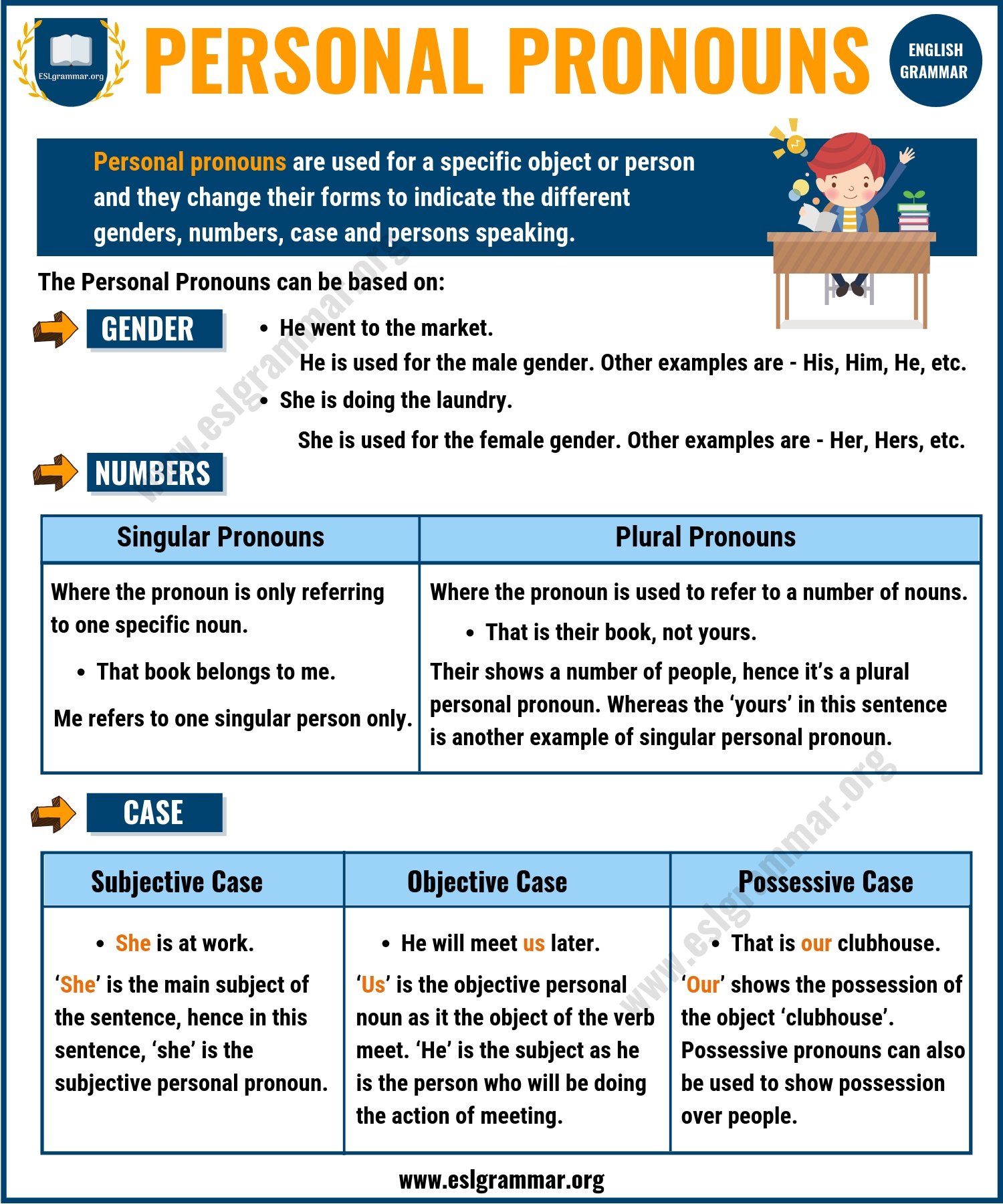
Personal pronouns are used for a specific object or person and they change their forms to indicate the different genders, numbers, cases, and persons speaking.
We can see that the Personal Pronouns can be based on:
Gender:
Pronoun examples: He, His, Him, Her, Hers, She, Them, etc.
- He went to the market.
- She is doing the laundry.
- It is important to them.
- …
Number:
Singular Pronouns – Where the pronoun is only referring to one specific noun.
- That book belongs to me.
Plural Pronouns – Where the pronoun is used to refer to a number of nouns.
- That is their book, not yours.
Cases:
Subjective Case: She is at work.
Objective Case: He will meet us later.
Possessive Case: That is our clubhouse.
Demonstrative Pronouns
What is a demonstrative pronoun?
Demonstrative Pronouns are used to show or identify one or a number of nouns that may be far or near in distance or time. They are only four in number – This, That, These, and Those.
Pronoun examples:
- That is a beautiful house.
- These were made by me.
- Everyone remembers those days.
- This is what he is charging?
- …

Interrogative Pronouns
What is an interrogative pronoun?
Who, Whom, Which and What are Interrogative Pronouns as they are used to ask questions about a person or object that we do not know about. Compounds of these words are made by attaching ‘-ever’ to the words to strengthen the emphasis on the word.
Pronoun examples:
- Which one would you like?
- What is your name?
- Who will be managing the buffet?
- Whom did you tell about this?
- Whoever could have done this?
- Whichever one will you choose?
- …

Relative Pronouns
What is a relative pronoun?
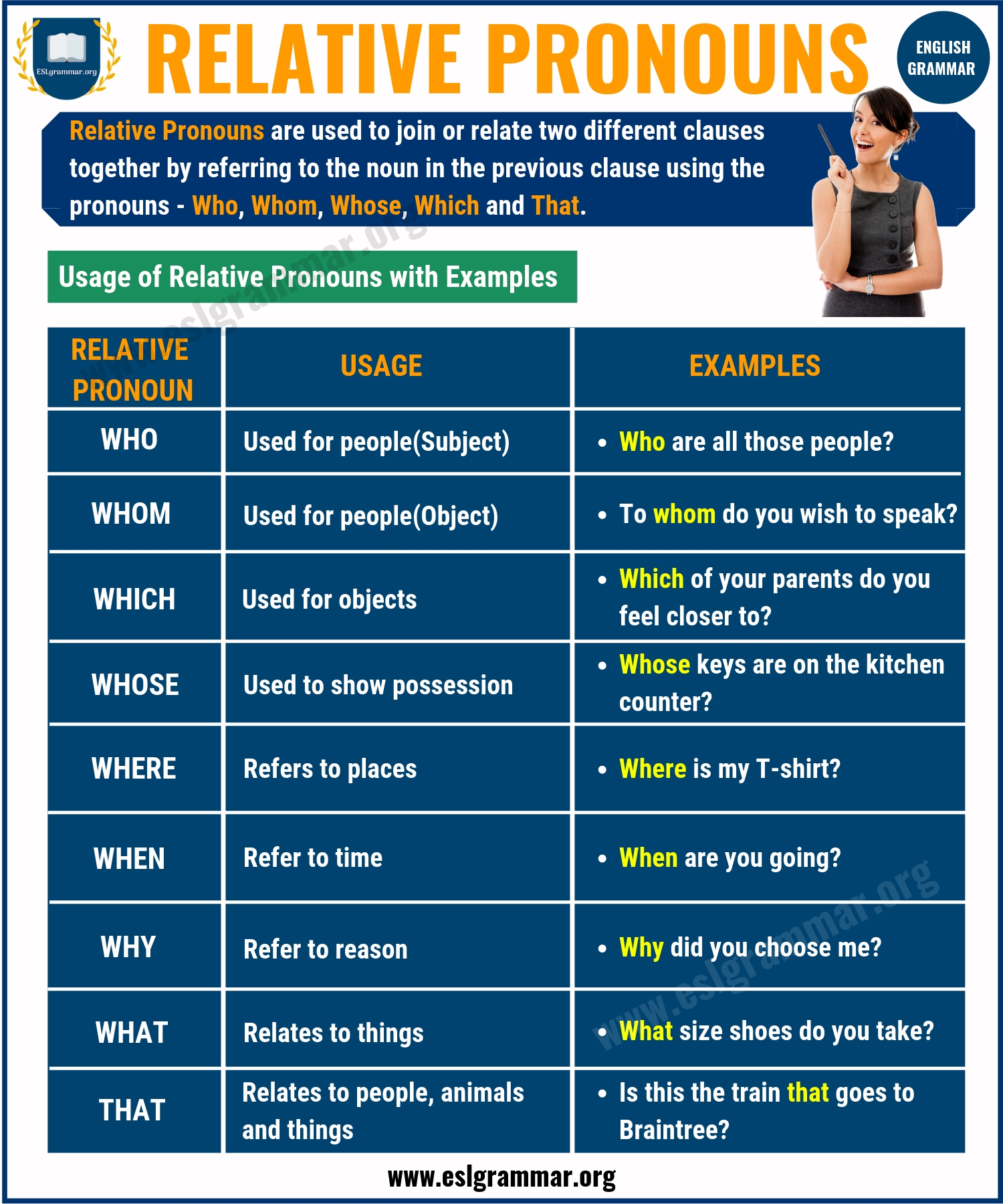
Relative Pronouns are used to join or relate two different clauses together by referring to the noun in the previous clause using the pronouns – Who, Whom, Whose, Which, and That.
Pronoun examples:
- She will choose the color which looks good on everyone.
- She is complaining to whoever she comes across nowadays.
- There is a car in the parking lot that someone has painted bright pink.
- She needs to know by tomorrow who will be accompanying her on the trip.
- Is there anyone here whose mobile phone has a signal?
- …
Indefinite Pronouns
What is an indefinite pronoun?
Indefinite pronouns are used to show unspecified objects or people, whether in plural or in singular. They are used to indicate the entire noun or some of the nouns or none of the nouns.
Some common indefinite nouns are – anyone, someone, none, everything, many, few, etc. For examples:
- If anyone has seen my notebook please return it to me.
- A few of the members were not satisfied with the service.
- Nobody was answering when I called them last.
- …

Reflexive and Intensive Pronouns
Reflexive Pronouns are those which are used to indicate a noun that has been used in an earlier part of the same sentence. These pronouns are – Myself, Themselves, Yourself, Ourselves, Herself, Himself and Itself.
- Rosa was going to take it to the shop but ended up fixing it herself one afternoon.
Here, we can see that herself is being used to refer to ‘Rosa’ again at the end of the sentence.
- He prefers to be by himself after a game.
Here, himself is used to refer to ‘him’.
- Apart from ordering in, they cooked a few snacks themselves.
Here themselves is used to show that ‘they’ cooked something.
- The horse hurt itself while trying to escape.
Since itself is a gender-neutral pronoun, it is used to show the nouns that have no definite gender. E.g.: material things or ideas, etc.; or whose gender is unknown. E.g.: animals.
These same words are also called Intensive Pronouns, which are used to lay emphasis on the pronoun that comes before them in the sentence.
- They themselves knew that the prank was in bad taste.
Here, the pronoun themselves is used to emphasize ‘they’.
- Avoid reporting things that you yourself haven’t witnessed.
Here yourself is used to emphasize the pronoun ‘you’.
Reciprocal Pronoun
There are just two Reciprocal Pronouns: Each other and One another. They are used when two or more nouns are doing or being the same to one another. Both of these pronouns are plural in nature as they can only be used in situations where there is more than one noun.
- Jamie and Jack always sit beside each other during the breaks.
Here, the reciprocation is between the children as they both sit together.
- They haven’t seen one another since last year.
Here, neither of the two parties has seen each other in some time.
- The trees seem to reach towards each other in a strong wind.
Here, we have an unspecified amount of trees bending towards the others in a strong wind.
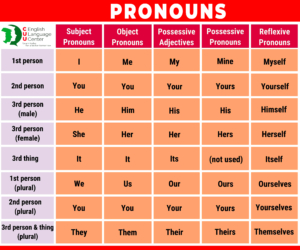
Types of Pronouns Chart

Personalización
Al ofrecer servicios adicionales como clases particulares y tutores, garantizamos un enfoque personalizado y adaptado a las necesidades individuales de cada estudiante. Esto aumenta la eficacia del aprendizaje y mejora la capacidad del estudiante para comprender y aplicar el idioma.
Soporte adicional
Nuestros servicios adicionales proporcionan a los estudiantes el apoyo extra que necesitan para tener éxito en su aprendizaje del idioma. Los tutores y las clases particulares ayudan a los estudiantes a superar los desafíos y dificultades del idioma, lo que les permite alcanzar su máximo potencial.
Experiencia y habilidades
Nuestros tutores altamente capacitados y experimentados en la enseñanza del idioma, aseguran que nuestros estudiantes reciban la mejor educación posible en el idioma. Los tutores brindan a los estudiantes una comprensión más profunda del idioma y las habilidades necesarias para aplicarlo en situaciones reales.
Bueno para mejorar
En CUU English Language Center, entendemos que el tiempo es valioso, por lo que ofrecemos horarios flexibles que se ajustan a sus necesidades.
Nuestros tutores pueden venir a su lugar de trabajo, su casa, o en nuestras aulas para impartir clases privadas en el momento que sea más conveniente para usted.


